|
HINWEIS | SCHLIEßUNG DER GESCHÄFTSSTELLE: 19. Dezember 2025 – 6. Januar 2026
|
|
Unsere Geschäftsstelle bleibt vom 19. Dezember 2025 bis zum 6. Januar 2026 geschlossen. Ab dem 7. Januar 2026 sind wir wieder wie gewohnt für Sie erreichbar.
Wir wünschen Ihnen eine frohe und besinnliche Weihnachtszeit sowie einen erfolgreichen Start ins neue Jahr!
Herzliche Grüße,
Ihr Team der Geschäftsstelle
|
|
|
Jahrestagung der Südosteuropa-Gesellschaft
|
|
|
27. – 28. Februar 2026, Regensburg
|
|
SYMPOSION DES WISSENSCHAFTLICHEN BEIRATS
Make Illiberalism Great Again – How the Orbán Government is Forging Transnational Alliances
Freitag, 27. Februar 2026, 15:00 – 17:00 Uhr
Regensburg / Online via Zoom |
|
|
US-Präsident Donald Trump und der ungarische Ministerpräsident Viktor Orbán im weißen Haus (Wikimedia Commons) |
|
|
About
Over the past decade, Hungarian Prime Minister Viktor Orbán has emerged as a central node in the global rise of illiberal politics. Far from being a purely domestic project, Orbán’s model of “illiberal democracy” has increasingly been articulated, legitimized, and expanded through transnational networks that connect political leaders, think tanks, media actors, and economic interests across borders. This symposium examines how the Hungarian government has been actively seeking to transnationalize its political project and position itself as a reference point for like-minded forces in Europe and beyond.
The event will focus on Orbán’s efforts to cultivate strategic alliances, most prominently with actors in the United States. Particular attention will be paid to his relationship with Donald Trump and to connections with conservative intellectual infrastructures such as the Heritage Foundation and other institutions in Europe and beyond that provide ideological support, policy templates, and platforms for mutual legitimation and the dissemination of ideas (e.g. Mathias Corvinus Collegium). In addition, the symposium will explore Hungary’s regional strategy in the Western Balkans, in particular the expansion of Hungarian political and economic influence in the region through investments in media ownership and communication infrastructures.
Introduction
- Dr. Sonja Priebus, Europa-Universität Viadrina, Frankfurt/Oder
Speakers
- Ivana Ranković, Belgrade Centre for Security Policy, Belgrade
- Dr. Gábor Scheiring, Georgetown University Qatar, Doha
- Zsuzanna Végh, German Marshall Fund of the United States, Berlin
|
|
|
Anmeldung
|
|
Die Veranstaltung findet im hybriden Format statt. Wir bitten um Anmeldung bis spätestens 23. Februar 2026 unter folgendem Link:
|
|
MITGLIEDERVERSAMMLUNG (nur für Mitglieder der SOG)
Freitag, 27. Februar 2026, 18:00 – ca. 20:30 Uhr
Regensburg / Online via Zoom |
|
ÖFFENTLICHE JAHRESHAUPTVERSAMMLUNG
Samstag, 28. Februar 2026, 10:00 – 13:00 Uhr
Regensburg / Online via Zoom |
|
|
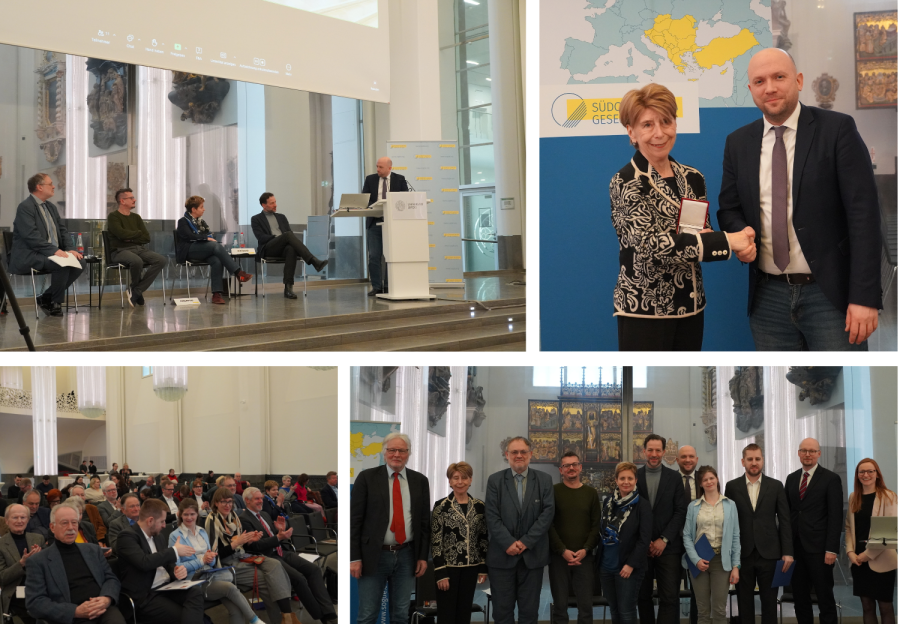
Rückblick Jahreshauptversammlung 2025 |
|
|
Eröffnung und Grußworte
- Manuel Sarrazin, Präsident der Südosteuropa-Gesellschaft
- Botschafter Michael Reiffenstuel, Beauftragter für Südosteuropa, die Türkei, OSZE und Europarat, Auswärtiges Amt
Verleihung des Dissertationspreises der Fritz und Helga Exner-Stiftung
Preisträgerin
- Dr. Claudia Laštro: "Do elite splits stabilise autocratic regimes? Case studies of Serbia and Montenegro"
Podiumsdiskussion
Ageing Societies and Immigration in Southeast Europe – Real Challenges and Imagined Threats
Speakers
- Prof. Dr. Florian Bieber, Center for Southeast European Studies, Universität Graz
- Aynur Kanafina, Regional Programme Specialist on Population and Development, UNFPA Regional Office for Eastern Europe and Central Asia
- Prof. Dr. Eva Fodor, Professor of Gender Studies, Central Eurpean University, Vienna/Budapest
- Prof. Dr. Maja Gerovska Mitev, Professor of Social Policy, University of Skopje
Chair
- Prof. Dr. Ulf Brunnbauer, Leibniz Institute for East and Southeast European Studies, Regensburg
About
Hardly any other region draws as much attention to demographic developments as Southeast Europe: when new census results are released, the media are full of reports about advancing depopulation and some commentators paint catastrophic scenarios of national demise. Indeed, emigration and low birth rates are causing the populations of the region to decline across the board. The UN predicts that this trend will continue over the coming decades. Such projections attract widespread media coverage, even though they have repeatedly proven retrospectively to be either too pessimistic or too optimistic.
The aim of the panel discussion is, first, to identify the social challenges that arise as societies adapt to changing demographics and an ageing population. These challenges concern not only pension and care systems but also the broader issue of migration, since immigration is the only realistic way to keep population numbers at least somewhat stable (yet, in Southeast Europe as elsewhere, there are strong critics of immigration). In this context, the discussion will also raise questions about Europe-wide interdependencies: How fair is it, for example, when care workers from Southeastern Europe are recruited to alleviate shortages in local care systems?
Secondly, the discussion will reflect on why demographic developments in Southeastern Europe—at times since the early 20th century—regularly provoke alarmist reactions, which repeatedly lead to the same political response: attempts to increase the birth rate (pro-natalism). Today, as in the 1970s, such efforts prove to be neither sustainable nor effective, and they have a negative effect on women’s emancipation. What role does demographic nationalism play in this, and how can it be overcome to pave the way for policies that prioritize welfare and rights instead of appeals to patriotic duty to have children?
The intention of the panel is to encourage an exchange of ideas among participants from different fields of expertise and to shed light on both political and social dimensions of the topic from various perspectives. The panel is organized by the research project “Anxieties of Ageing in Southeastern Europe,” funded by the Volkswagen Foundation, which recently conducted a comprehensive survey in the region on demographic perceptions. |
|
|
Anmeldung
|
|
Die Veranstaltung findet im hybriden Format statt. Wir bitten um Anmeldung bis spätestens 23. Februar 2026 unter folgendem Link:
|
|
|