
History of the SOG
Rebuilding Relations with the Region in the Postwar Period
The Southeast Europe Association (SOG) was founded in Munich in 1952 to rebuild relations with the countries of the region, which had been shattered by World War II. At the intersection of academia, politics, business, and the media, it aimed to promote the exchange of knowledge and culture, convey expert insights to the public, and establish professional networks.
The SOG's Founding Was Largely Driven by Individuals with Ties to the Nazi Era
The initiative was launched by historian Fritz Valjavec, who also served as managing director (and later director) of the Munich-based Institute for Southeast European Studies, which was founded in 1930 and reopened in 1951. In addition to the SOG, Valjavec founded the Southeast German Cultural Association in Munich in 1952 and the Southeast German Historical Commission in 1957.
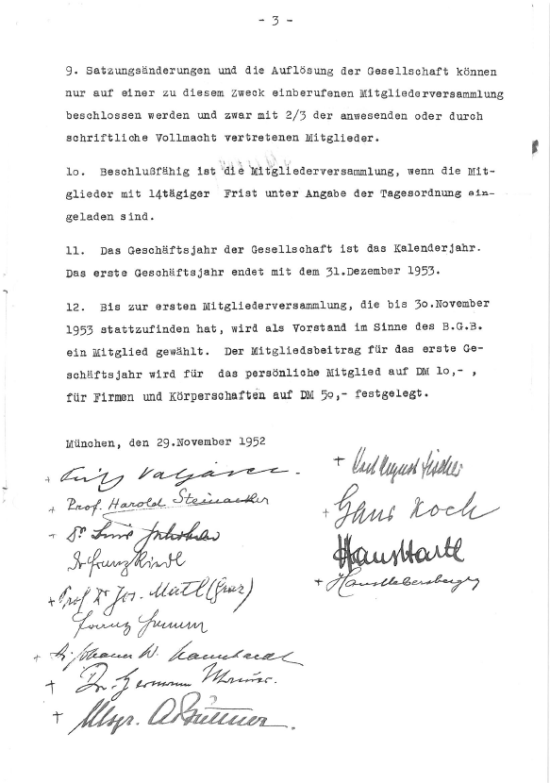
Fritz Valjavec and twelve other founders of the Southeast European Association had, for the most part, known each other since the war and prewar years. Among them were Professors Fritz Valjavec, Harold Steinacker, Hans Koch, Hans Übersberger, Hans Hartl, Franz Hamm, Johann W. Mannhardt, and Josef Matl, as well as Dr. Boris Tschoban, Dr. Franz H. Riedl, Dr. Hermann Maurer, Msgr. Albert Büttner and Karl August Fischer. All had built their careers in the Nazi state. As members of the NSDAP or other Nazi organizations, they had, to a greater or lesser extent, placed their expertise at the service of Hitler's policies of ethnic nationalism and conquest. Nevertheless, they were able to continue their careers in the early Federal Republic by concealing their past and offering their services to "enemy research," which had become highly sought after during the Cold War.
Fritz Valjavec, too, had been involved in research on ethnic Germans and enemies of the “Third Reich.” He had held the rank of SS-Untersturmführer and had served as an interpreter in an Einsatzgruppe of the Security Police and the Security Service during the war in Eastern Europe. Since he was facing political attacks after the war, he only became “executive member of the SOG’s board” after 1952. In 1954, the high-profile position of president was instead assumed by a personality with no historical baggage: the economist and SPD politician Wilhelm Gülich, who had never been a member of the NSDAP. He was succeeded in 1960 by the journalist and CDU politician Rudolf Vogel, whose Nazi past only came to light much later (see below).
At all levels—the executive board, staff, and members—continuities with the Nazi era prevailed in the 1950s. Personal ties to the Hitler regime, which had subjected Southeast Europe to an unprecedented war of aggression, plunder, and extermination, initially made it difficult for the SOG to establish contact with scholars from the region's countries (now largely under communist rule). Mistrust was also fueled by the association's role as a gathering place for former representatives of the ethnic German minorities, displaced persons, and emigrants.
The Beginning of a Generational Shift and the Expansion of the Program in the 1960s
Although the legacy of the past continued to have an impact for some time, the SOG succeeded in the 1960s in establishing and expanding cooperation with its partner countries through its annual meetings, international academic weeks, and conferences. Through its journal "Südosteuropa Mitteilungen", launched in 1961, it also gained greater visibility and prestige among international experts.
As an intermediary organization within the framework of the "third pillar" of German foreign policy—foreign cultural and educational policy—the SOG received institutional funding from the Federal Foreign Office as early as the 1960s. This enabled it to develop an increasingly extensive program of events and publications and to explore new subject areas.
The 1960s also saw a generational shift. In 1965, Walter Althammer, a CSU member of the Bundestag, became president of the association; he was succeeded in 2000 by Gernot Erler, an SPD member of the Bundestag and prominent foreign policy expert. Since 2020, the SOG has been led by former Bundestag member Manuel Sarrazin (Alliance 90/The Greens).
New Challenges After the End of the Cold War
Since the dissolution of the blocs in Europe in 1989, the SOG has devoted its attention to the social, political, and economic transformation in the former socialist countries. Soon afterward, the Yugoslav successor wars led to an increasingly intensive and timely focus in the SOG's operational work. In addition to academic activities across various disciplines, this has included—and continues to include—track-two activities, such as fostering networks among civil societies in and with the region through conferences and workshops.
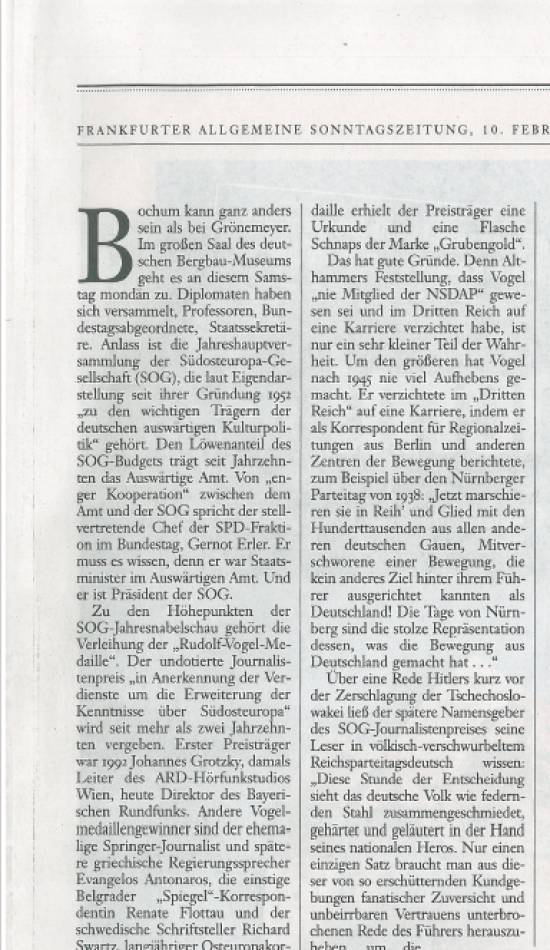
In 2013, the SOG began to come to terms with its history after the Nazi propaganda activities of its former president, Rudolf Vogel, were uncovered. The "Rudolf Vogel Medal," which had been awarded up to that point, was subsequently renamed the "Southeast Europe Association Journalism Award." That same year, the symposium "The Prehistory and Founding of the Southeast Europe Association: Critical Questions Regarding Contexts and Continuities" took place. (Report) The Southeast Europe Association's archive was transferred to the Bavarian Main State Archives and has been available to researchers ever since. In 2025, the SOG addressed the topic "Forgotten Aspects of Germany's Historic Responsibility—German Occupation in Southeast Europe During World War II" at an international conference held in Berlin. However, the process of coming to terms with Germany's Southeast European policy and research during the Nazi era is far from complete.
Today, conflict resolution, democratization, socioeconomic transformation, and the European integration of Southeast European countries remain the focus of numerous events. In addition, transnational and global challenges are addressed, including migration and demographic crises, climate change, and environmental protection. Finally, the SOG is increasingly focusing on the role of external powers in the region. Throughout all of this, however, the region's languages, cultures, and history remain central themes of its work.
Text: Prof. Dr. Marie-Janine Calic, September 2026