
Another Round of Early Parliamentary Elections in Bulgaria: From Bad to Worse?
Speakers
- Alexander Andreev, Analyst at Capital.bg
- Mila Moshelova PhD, Postdoctoral Researcher (Sofia University) and Political Analyst (Decogito)
- Maria Simeonova, Head of Office – Sofia, European Council on Foreign Relations (ECFR)
- Ruslan Stefanov, Program Director & Chief Economist, Center for the Study of Democracy (CSD), Sofia
Moderation
- Dr. Johanna Deimel, Vice President of SOG, Munich
On the topic
On 19 April 2026, Bulgaria is heading to yet another snap parliamentary election, marking the latest episode in a prolonged period of political instability that has seen eight elections in five years. The vote follows the resignation of the Rosen Zhelyaskov government in late 2025 after massive anti-corruption protests across the country. Once again—for the eighth time since 2016—Bulgaria is being led by a caretaker government, and the country appears to be stuck in political uncertainty.
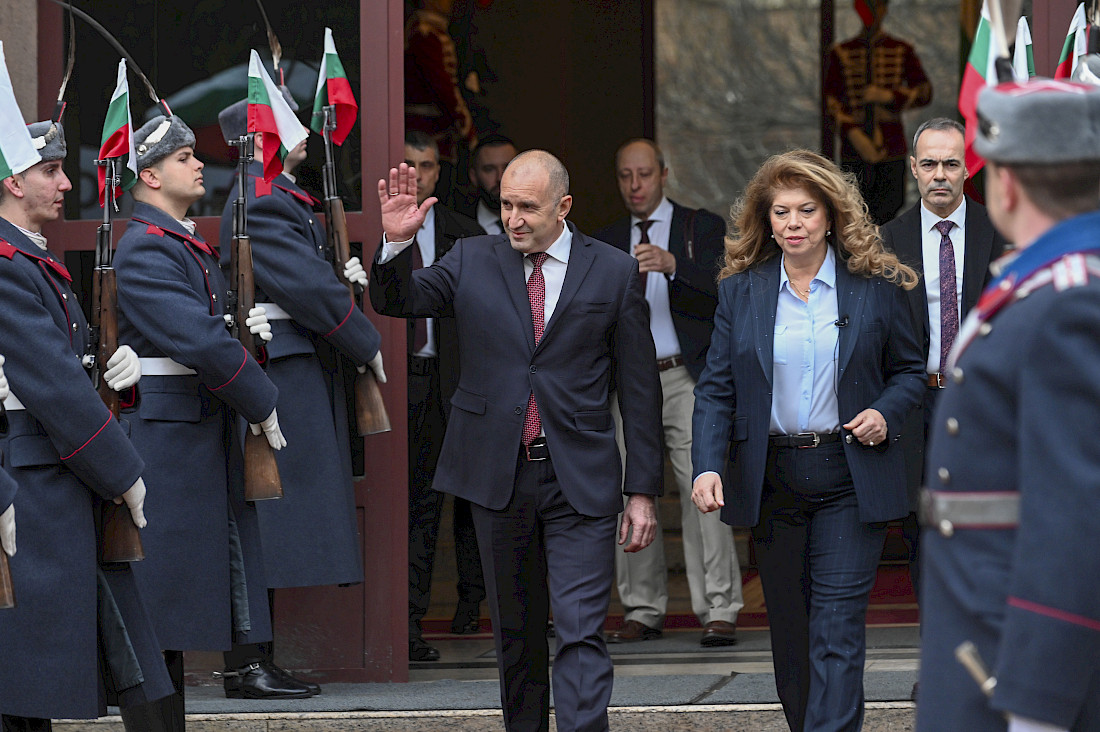
It is not only the parliamentary elections in Hungary that could prove decisive for Europe. In Bulgaria, too, the country’s European course may be at a crossroads. For the first time in the country’s history, the President, Rumen Radev, has resigned and will run in the elections with his newly founded party, “Progressive Bulgaria.” The admitted Eurosceptic – who is also considered a Russophile – promises to fight the oligarchy and is leading in the polls with roughly 30%.
Current polls suggest that the National Assembly will feature a fragmented political landscape and that forming a government will once again prove difficult. Boiko Borisov (GERB) and Delyan Peevski (DPS-New Beginning), who are viewed by many Bulgarians as key figures behind the oligarchy and corruption in the country, can expect to receive roughly 20% (GERB) and 10% (DPS-New Beginning). The reform-oriented coalition “We Continue the Change”–“Democratic Bulgaria” is currently polling at around 11%, while the far-right “Vazrazhdane” stands at 8%. It is unclear whether the Bulgarian Socialist Party (BSP) will pass the 4% threshold. If the BSP succeeds, a pro-Russian majority might emerge in parliament.
The elections once again raise fundamental questions about Bulgaria’s political direction, governance stability, and reform capacity—particularly in light of growing concerns with regards to corruption and Russian influence. Beyond domestic politics, the election outcome will also have wider implications: What will the results mean for Bulgaria’s role within the European Union and NATO and in relation to Russia and Ukraine? How might the election outcome affect regional security in the strategically important Black Sea region? These questions and topics will be discussed by our distinguished speakers in the framework of our online discussion right after the elections.
Am 21.04.2026, 16:30 h
Venue: Online via Zoom